
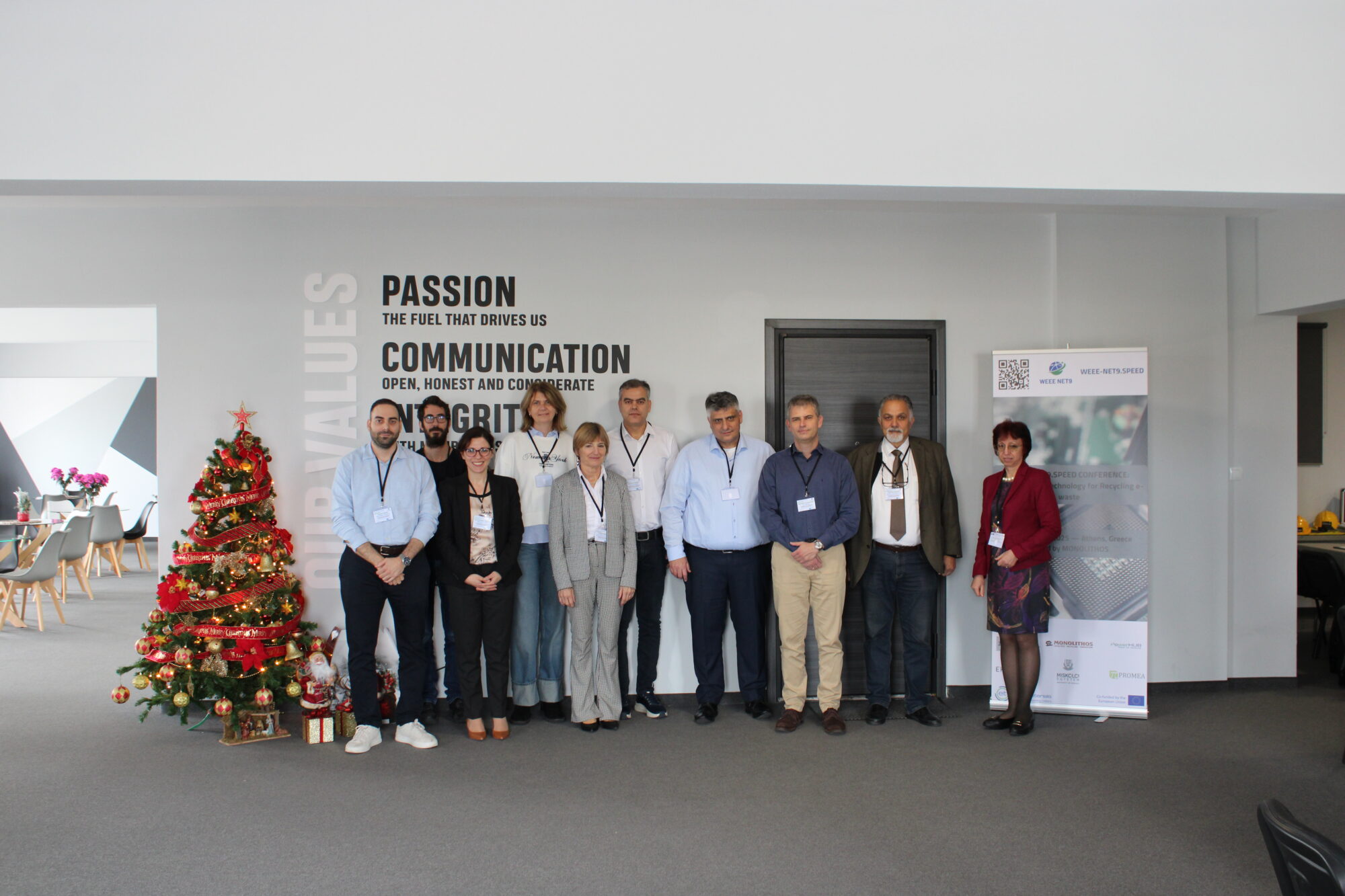
The conference kicked off with a warm welcome by Dr. Iakovos Yakoumis (MONOLITHOS), who set the tone for the day by underlining the growing challenge — but also the immense opportunity — represented by waste electronic and electrical equipment (WEEE). With electronic consumption rising across Europe, WEEE has become one of the fastest-growing waste streams in the EU.
Yet, this growing mass of discarded electronics doesn’t just spell environmental risk: hidden inside those devices are critical raw materials (CRMs) — metals and materials essential for digital infrastructure, green technologies, and future industries. Recovering those materials from e-waste, rather than mining new ore, presents a major opportunity for resource efficiency, supply-chain resilience, and circular economy growth across Europe.
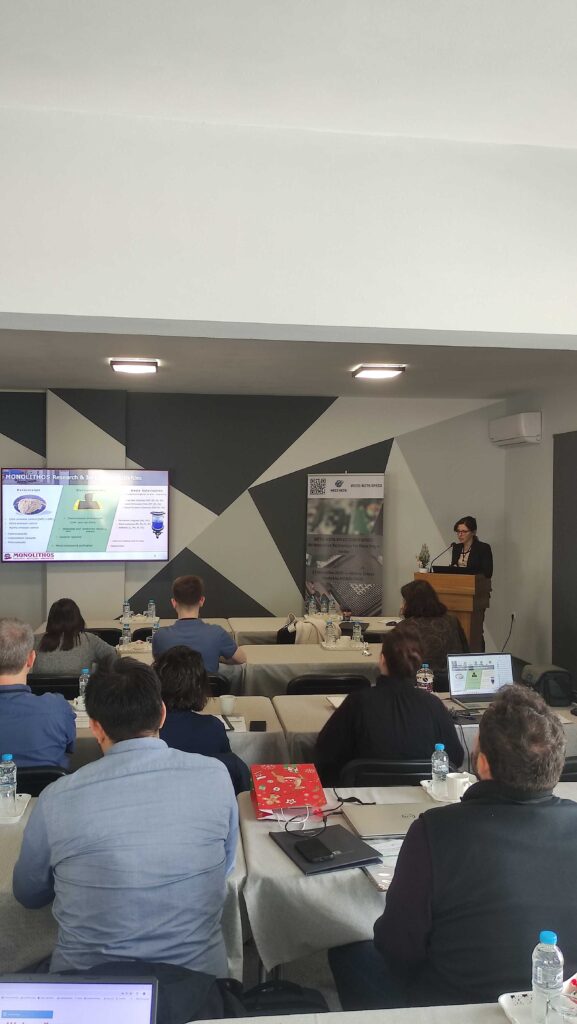
Following the welcome, Dr. Anastasia-Maria Moschovi introduced MONOLITHOS: the company’s history, its role in catalysis and recycling, and their ongoing R&I (research & innovation) activities. She framed the company’s mission as both ecological and industrial: developing scalable, sustainable recycling solutions that can integrate into Europe’s circular-economy ambitions.
Project Overview: What is WEEE-NET9.SPEED
Next, the spotlight turned to the project at the heart of the conference: WEEE-NET9 (and specifically its scaling-up project, WEEE-NET9.SPEED). Presented by Dr. Dragica Marinič from ZAG (Slovenia), the overview laid out the project’s mission: to empower local recyclers — especially in “Regional Innovation Scheme” (RIS) countries in East and Southeast Europe — by transferring cutting-edge recycling technologies, building networks between industry, academia and policy, and establishing a robust value chain for WEEE recycling and CRM recovery.
WEEE-NET9 – and by extension WEEE-NET9.SPEED – aims to combine a mixture of advanced methods — gravitational, hydro-metallurgical, physico-chemical, and bio-leaching — to extract CRMs from electronic waste. This hybrid approach seeks to maximize recovery efficiency while minimizing ecological footprint.
The benefits are compelling: recovery rates reportedly exceeding 96% for a range of critical metals and CRMs; and, compared to traditional smelting, the process can cut CO₂ emissions significantly (projected savings of 418 kilotons per year for the EU, and up to 30% lower environmental footprint).
Moreover, WEEE-NET9 aims not just at technology, but at building capacity: through matchmaking events, support for business development, and promoting entrepreneurship and scale-ups in recycling. By doing so, the project strives to cement WEEE recycling and CRM recovery as pillars of the European circular economy.
Policy & Strategic Context: Why the EU Needs Circular E-Waste Solutions
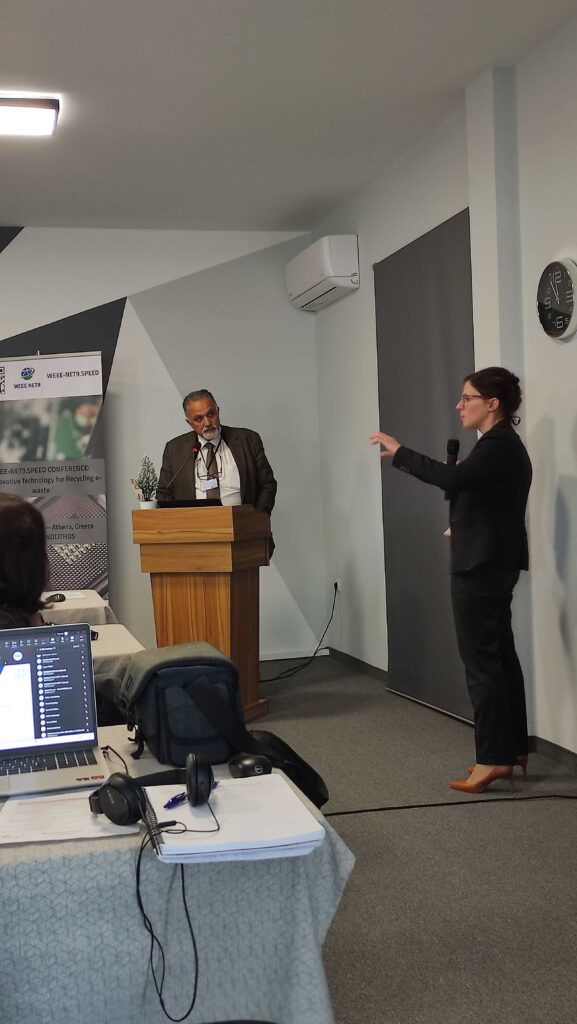
The third session, led by Dr. Antonis Gypakis (General Secretariat for Research & Innovation, Greece), framed WEEE recycling not as a niche environmental concern — but as a strategic necessity for Europe’s green, digital, and geopolitical transitions.
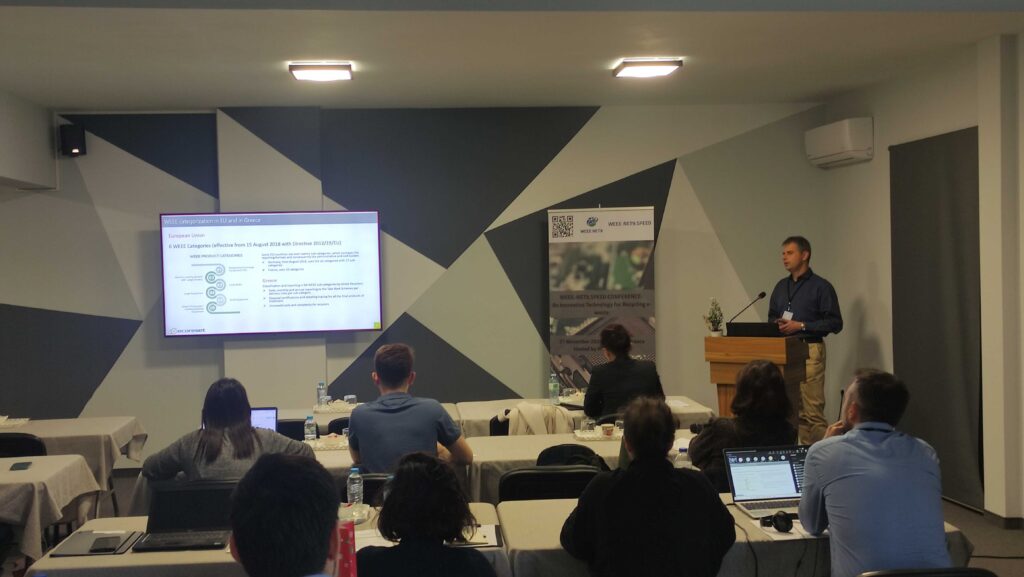
Under the regulatory umbrella of the WEEE Directive (2012/19/EU) and the RoHS Directive (2011/65/EU), EU member states are required to meet collection, recycling and recovery targets for WEEE, and to restrict hazardous substances in electronics.
Still, compliance and ambition have lagged: according to recent assessments, many countries still fail to meet minimum collection or recycling targets — and the overall recovery of critical raw materials remains low.
Dr. Gypakis emphasized how projects like WEEE-NET9.SPEED — and the innovation they bring — are essential to closing that gap. European policy pushes for circularity, not just waste disposal; eco-design and extended producer responsibility (EPR) must be complemented by robust recycling infrastructure and advanced recovery technologies.
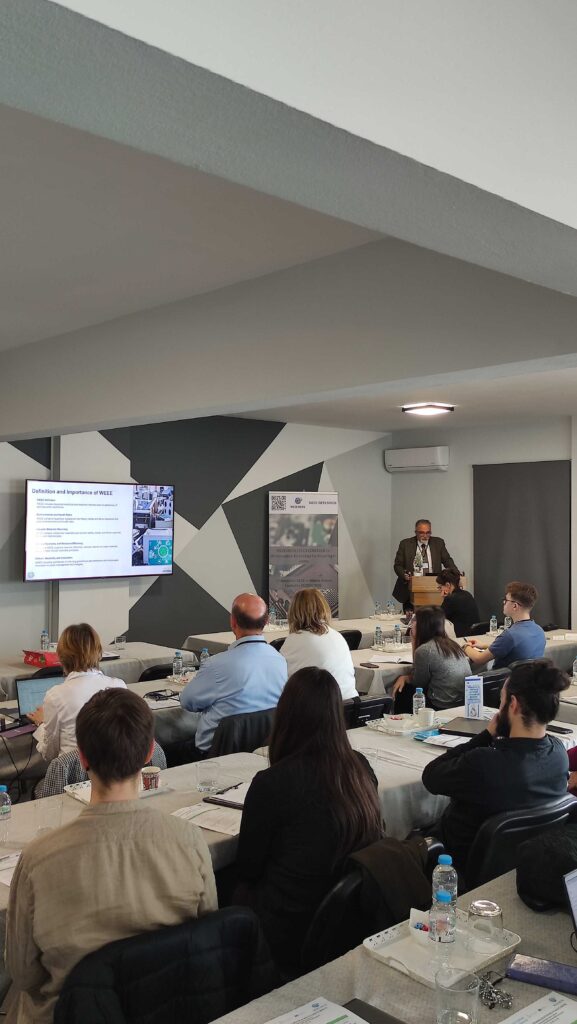
The slide deck shown during the presentation highlighted key directives and strategic initiatives, and framed the conference as part of the broader “Circular Economy Action Plan” and aims to secure Europe’s resource autonomy. This places e-waste recycling not only in environmental terms, but also economic and strategic ones — helping Europe avoid overreliance on imported raw materials in a volatile global market.
Scientific & Technical Innovations: From Bio-leaching to AI Sorting
One of the strongest parts of the conference was the showcase of concrete technologies and scientific strategies — from advanced chemistry to digital automation — aiming to transform WEEE recycling from a marginal activity into a high-tech, competitive industry.
🔬 Mechanochemical & Bio-leaching Technologies
Prof. Zara Cherkezova-Zheleva (Bulgarian Academy of Sciences) described ongoing research into environmentally-safe extraction methods using mechanochemical and bio-leaching procedures. These innovations allow for the recovery of CRMs with reduced environmental impact compared to traditional metallurgical methods. This is directly aligned with the bio- and hydro-metallurgical methods promoted by WEEE-NET9.
🤖 Smart Sorting & AI — The Case of CRUSADE
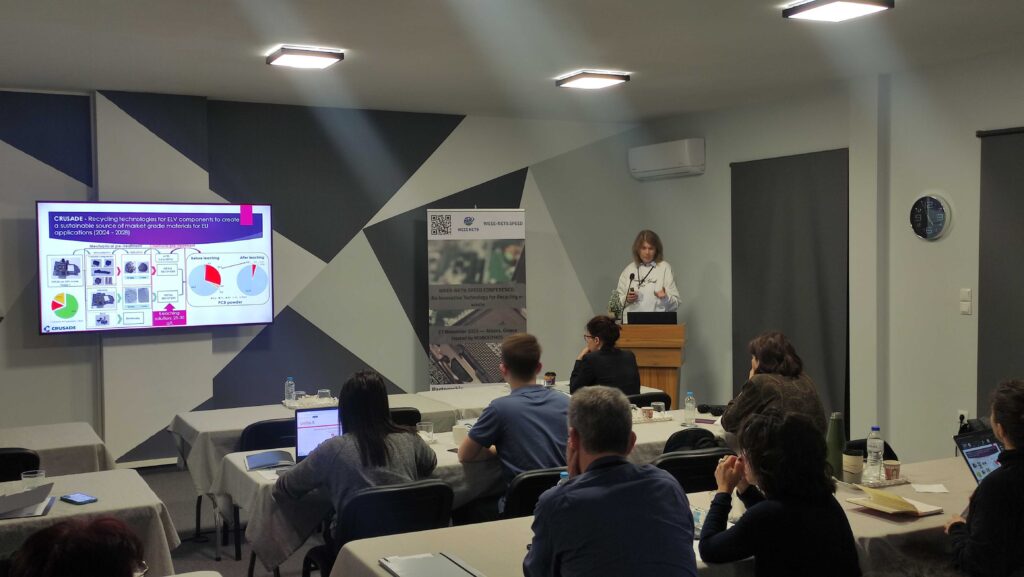
Representatives from Novamechanics (Dr. Dimitris Mintis & Dr. Antreas Afantitis) presented how machine-learning and AI-driven sorting algorithms can transform the early stages of recycling — automatically identifying, classifying, and sorting end-of-life components, especially in complex waste streams like printed-circuit boards. Such automation is crucial to dealing with large volumes of WEEE and ensuring components are treated properly before metallurgical processing.
Interestingly, although CRUSADE is primarily focused on automotive waste streams (e.g., spent catalytic converters, batteries, fuel cells and printed circuit boards from end-of-life vehicles), its methodology and technology approach — especially automated sorting and hydrometallurgical recovery — can be adapted for broader WEEE recycling applications.
At scale, CRUSADE aims to recycle up to 500 tonnes per year of spent automotive components, recovering around 40 tonnes per year of critical raw materials like Cu, Co, Ni, Pt, Pd, Rh, Li, etc.
Although not identical to typical household WEEE, the parallels show how cross-sectoral recycling strategies (automotive & electronics) can converge — underscoring the value of hybrid projects like WEEE-NET9.SPEED that draw on diverse methods.
🧲 Magnet Recycling & Circular Supply — The PERMANET Perspective
Another major contribution came from Dimitris Kritikos (WEEEForum), who presented PERMANET — a European-funded initiative to establish a resilient supply chain for Rare Earth Permanent Magnets (REE PM) within Europe. PERMANET aims to build a network of stakeholders (industry, recyclers, R&D institutes) and develop a digital marketplace/hub to collect, trade and redistribute rare-earth materials recovered from waste streams.
This is vital because many high-performance technologies — from electric motors to renewables — rely on rare earth magnets. By recycling waste magnets and other rare-earth–bearing components, PERMANET helps close the loop, reducing Europe’s dependence on external sources.
The project’s ambition is not merely technical, but systemic: by creating a central digital hub / marketplace, PERMANET seeks to aggregate scattered waste streams and materials, turning what was once waste into valuable feedstock, ready for reuse in Europe’s industrial value chain.
This aligns closely with the circular economy vision championed by WEEE-NET9.SPEED. Indeed, PERMANET’s magnet recycling possibilities can complement WEEE recycling — especially when e-waste contains components like motors, hard drives, speakers, etc. that embed rare-earth magnets.
The Broader Significance: From Waste to Strategic Resource
Beyond the presentations, panels and technical sessions, a recurrent theme emerged: electronic waste is not just a liability — it’s a resource. As Europe races toward digitalization, electrification and net-zero goals, the demand for CRMs — copper, cobalt, rare earths, precious metals — is skyrocketing. Mining them from virgin ore is costly, environmentally damaging, and geopolitically risky. Recovering them from waste is smarter, greener, and makes Europe more resilient.
Estimates suggest that by 2050, the amount of CRMs embedded in e-waste could grow from around 1.0 million tonnes per year (2022) to 1.2–1.9 million tonnes per year. E-If recycling infrastructure and processes scale accordingly, Europe could potentially recover between 0.9 and 1.5 million tonnes of CRMs annually — effectively turning WEEE into a stable, circular supply of raw materials.
Thus, initiatives like WEEE-NET9.SPEED — combining cutting-edge recycling technologies, network building, business development, and policy alignment — are not just “nice to have.” They are indispensable for Europe’s green transition, resource security, and long-term sustainability.
Reflections, Networking & Next Steps
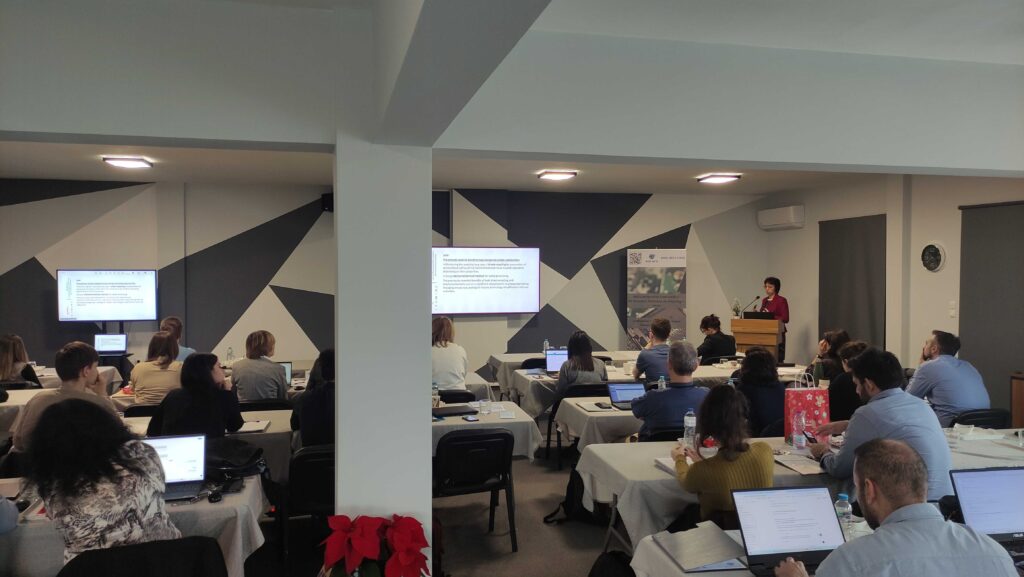
The closing session facilitated open discussion and networking — bringing together companies, research institutions, policymakers, and stakeholders. Many highlighted how important it is to scale up quickly, not just pilot projects: given the volume of e-waste and the urgency of resource supply, every year counts.
Comments included calls for:
- Faster transfer of recycling technology to local/regional recyclers (especially in under-resourced regions)
- Investments to modernize and standardize recycling infrastructure
- Better cross-sector cooperation (electronics, automotive, renewables) to pool waste streams
- Development of digital marketplaces (like PERMANET) and circular-economy business models
The event closed with optimism: the mix of proven science, policy drive, business strategy, and pan-European cooperation seen at WEEE-NET9.SPEED gives hope that WEEE can be transformed from a growing problem into one of Europe’s strategic assets.